
From Effort to Impact: The Power of Continuous Improvement
Many of us are familiar with the “Sisyphean task, a term referencing the Greek myth of Sisyphus, or we’ve at least heard a similar concept before: trying to accomplish something that feels like we’re pushing a boulder up a hill in a never-ending effort.
For those who strive to improve outcomes for youth, this can feel all too real. We operate within complex systems that leave adults feeling overwhelmed and children underserved. At times, this work can feel like a “Sisyphean task, or constantly pushing a boulder up a hill only for it to roll back down. If that’s the case, why even try?
We try because we know what’s at stake: the lives of our youth. In Jim Collins’ Good to Great, he describes the “flywheel effect,” another image of pushing something large and heavy, but with a crucial difference: instead of resetting each time, the wheel gains momentum. Every push builds on the last. Over time, consistent, collaborative effort compounds, making each turn easier until the wheel moves forward with steady force. Continuous improvement science in education does just this: it transforms the boulder into a flywheel.
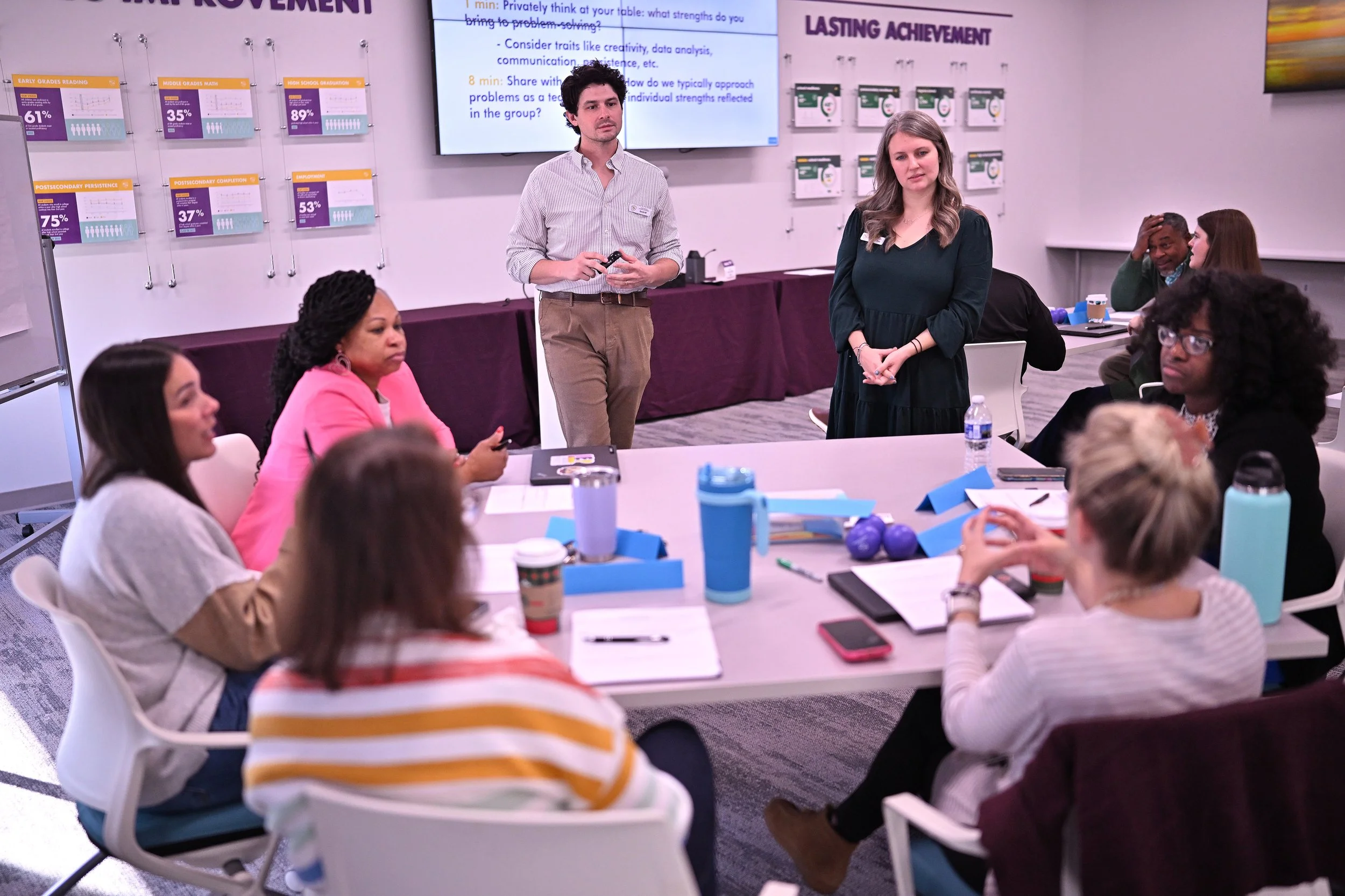
Wardlaw Center for improvement Science Continuous Improvement Coaches David Hill and Lauren Silver work with administrators from Spartanburg School District 6 on developing CI methods for identifying and addressing school-specific challenges such as academic achievement, truancy or attendance.
For many, working to transform educational systems is the metaphorical boulder. This mindset can lead to burnout and frustration, reinforcing the belief that meaningful change is out of reach. We can remain in this space and accept continued unsatisfactory results, or we can begin applying the flywheel concept by working bit by bit toward more sustainable and meaningful change. This is where continuous improvement (CI) science comes in, offering a structured approach to collaborative problem-solving. Through CI work, we move from effort that feels heavy and repetitive to effort that builds on itself over time, leading toward long-term impact.
What this means in practice is that improvement doesn’t occur as an isolated incident, nor does it occur through an isolated individual. Improvement work depends on a team that engages in structured learning, shared practice, and consistent collaborative problem solving. Everyone is capable of doing improvement work. As the saying goes, “it takes a village to raise a child,” and it’s that same village who improves the world in which the child thrives. Changing the system is overwhelming, but it’s not impossible. And, most importantly, it’s not done alone.
The Wardlaw Center for Improvement Science at Spartanburg Academic Movement is the homebase for improvement work in Spartanburg County. Wardlaw offers a partnership cycle, free to Spartanburg educators and non-profit partners, that provides the structure and support teams need to improve persistent problems within their work. By partnering with Wardlaw, a coordinated effort is formed to make that first push toward meaningful change.
The first step is to engage in structured learning offered through the Wardlaw Center. There is a methodological approach to improvement work, one that has been proven effective in other industries and other school districts across the nation. In taking this approach, we begin to move from isolated effort to intentional action, so that the work we do becomes impactful and meaningful, not just something else we tried and hoped would work.
Continuous Improvement Trainings are strategically designed to engage teams in a learning arc that moves them from thoughts and ideas to action and impact. The trainings are as follows:
• CI 101: Principles of Continuous Improvement (What is CI?)
• CI 102: Tools and Methodologies for Teams (How do we apply CI to our work?)
• CI 103: Practical Measurement (How do we know if we’re making an impact?)
While the trainings provide access to CI tools and methods, they are only the beginning. Real improvement happens through consistent application over time. That’s where coaching support from Wardlaw’s Continuous Improvement Coaches becomes essential. This support helps teams apply concepts in real time, navigate challenges, and sustain momentum as they turn learning into lasting impact.
Sisyphus was condemned to an eternity of meaningless effort, a never-ending cycle of pushing a boulder up a hill only to never reach the top. Continuous improvement work isn’t an initiative that will lose momentum and fall back down the hill. With the right approach and support, the work doesn’t reset – it builds. What once felt like a boulder becomes a flywheel, gaining momentum with every small, consistent push. That’s how real change happens and how better outcomes for youth become possible.
For more information, email WardlawCenter@learnwithsam.org. To register for CI courses, visit https://learnwithsam.org/trainings.