
From Birth to Kindergarten: What Spartanburg’s EDI Data Reveals About Early Childhood Success
Preparing children for success in school begins long before they ever enter a classroom. From birth to age 5, every experience, environment, and support system shapes how ready a child is to learn when kindergarten begins. The Early Development Instrument (EDI), administered in every Spartanburg County school district through Spartanburg Academic Movement, gives the community a population-level picture of how well our community is supporting young children during these critical early years.
EDI is not a test of individual children, it is instead a reflection of systems, neighborhoods, and community supports.
SAM released the results of the 2024-25 EDI during a meeting recently of early childhood stakeholders including school districts, First Steps, Mary Black Foundation, the faith community, organizations serving families, and others.
The EDI assesses readiness to learn across five domains: physical health and well-bring, social competence, emotional maturity, language and cognitive skills and communication skills and general knowledge.
Being ready for kindergarten requires readiness in all areas. Every domain is critical, and gaps in any area can impact long-term learning and development.
This year’s EDI cycle was the most comprehensive yet:
3,600+ kindergarteners across all seven districts, Meeting Street Academy, and Spartanburg Prep School, participated.
Teachers completed 103 questions across 5 domains.
Spartanburg achieved a 96.3% completion rate, reflecting strong educator engagement.
The majority of teachers have participated for three or more cycles, contributing to consistent, reliable data.
This thorough, countywide participation allows Spartanburg to understand not only the current picture, but change over time.
2024-25 EDI Results
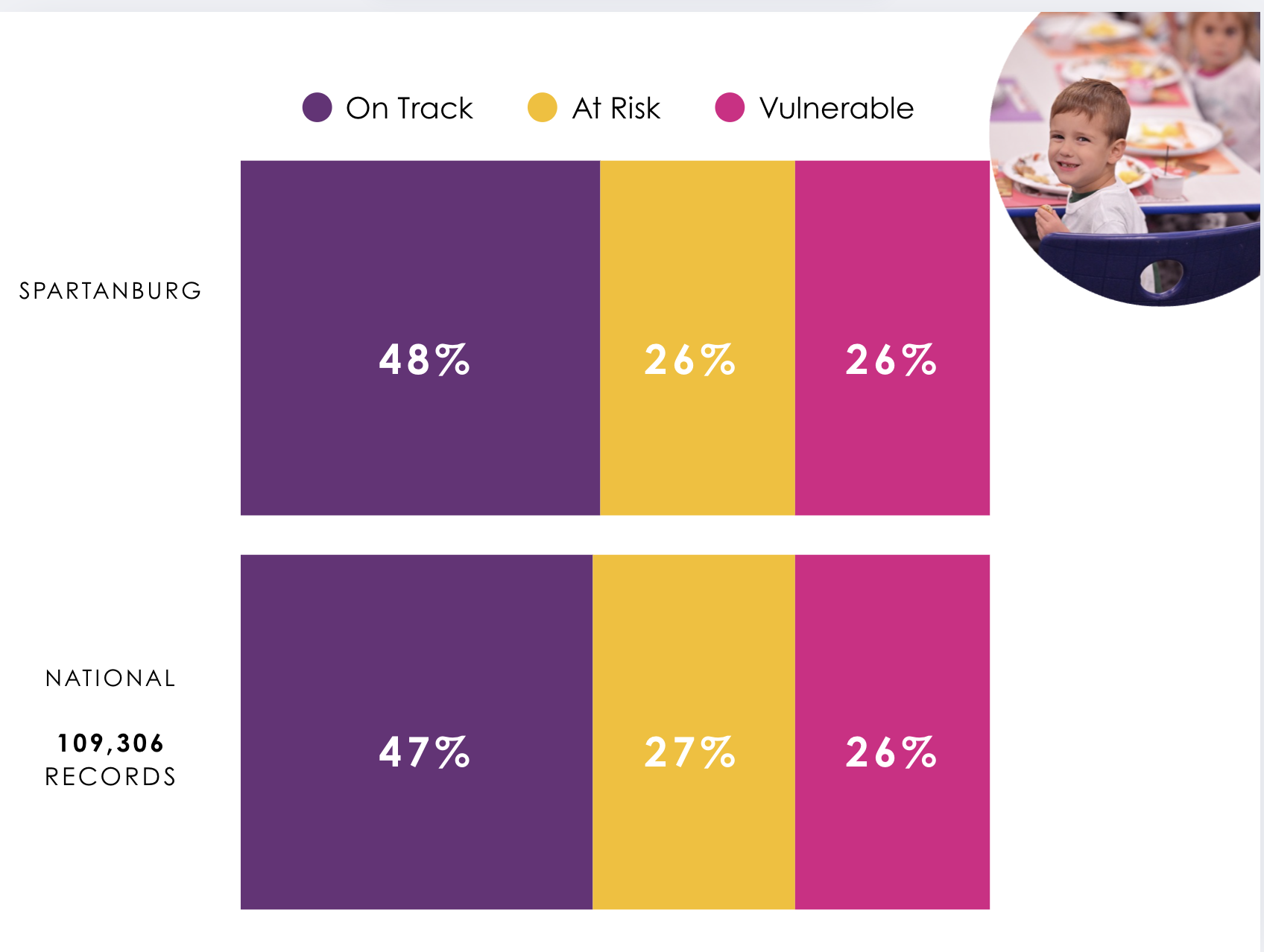
Results from the 2024 EDI shows only 48% of Spartanburg County kindergarteners are fully ready to learn, or meet on track in all five domains. Fifty-two percent aren’t ready, either at risk or vulnerable, in one or more areas. Spartanburg’s results mirror national data.
Results from the 2024 EDI shows only 48% of Spartanburg County kindergarteners are fully ready to learn or meet on track in all five domains.
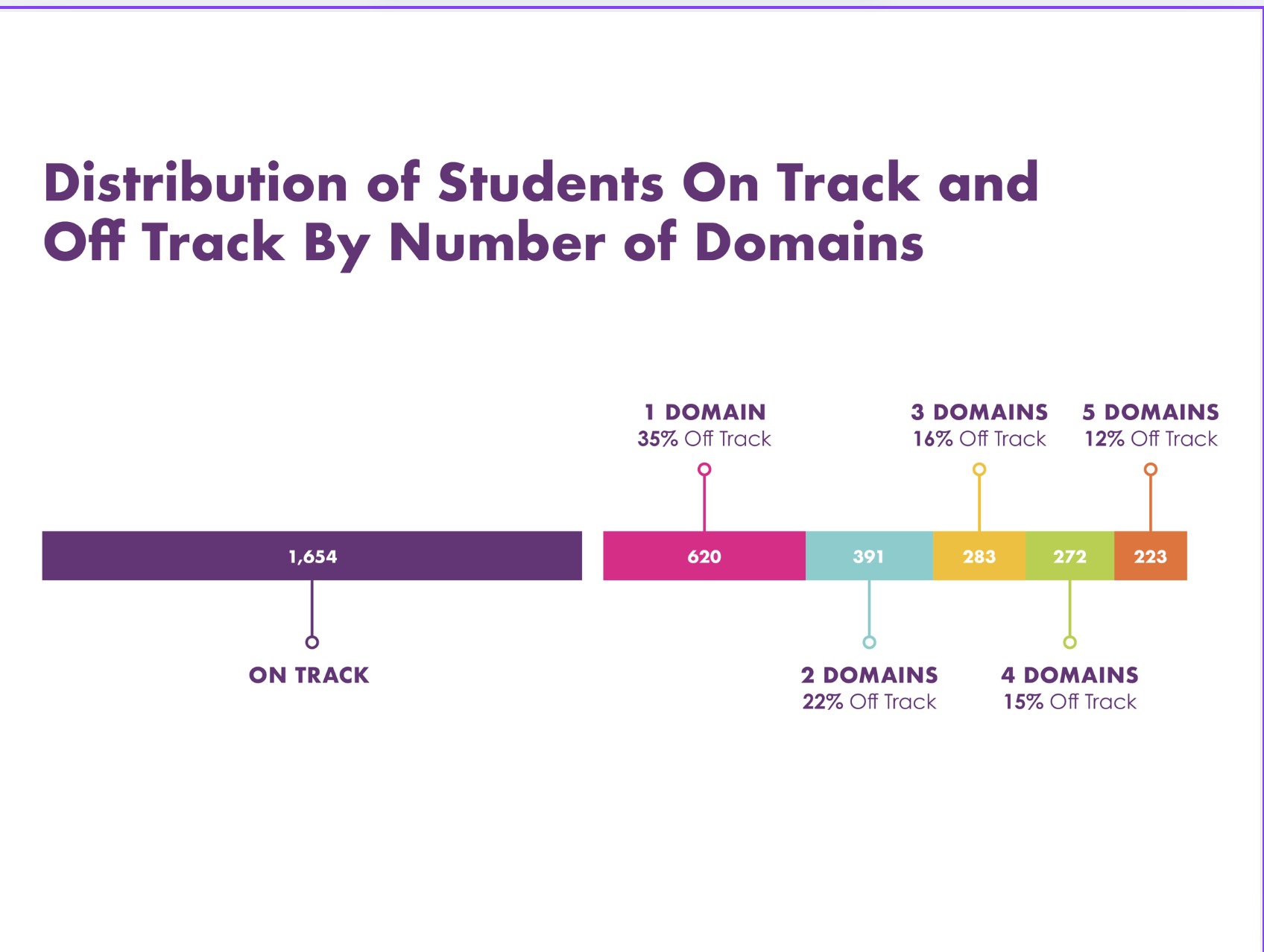
48% are on track in all domains (1,654 students)
52% are not ready, either at risk or vulnerable in one or more areas (1,789 students)
Spartanburg’s readiness levels closely mirror national results, but the data reinforces the need for targeted supports:
Spartanburg: 48% on track, 26% at risk, 26% vulnerable
National: 47% on track, 27% at risk, 26% vulnerable
Where Are Children Struggling Most?
Looking at the breakdown of children who are off track in just one domain:
42.1% struggle with Language & Cognition
20% with Emotional Maturity
17.4% with Physical Health & Well-Being
14.8% with Communication & Knowledge
5.6% with Social Competence
This clearly points to a need for expanded early literacy and numeracy and language-rich environments, along with supports for social-emotional development.
The EDI allows results to be mapped geographically to show patterns across neighborhoods.
Spartanburg has 87 census tracts.
The percentage of children on track in all five domains ranges dramatically from 0% to 100% depending on the neighborhood.
Overlaying factors such as preschool enrollment and the number of families with children under five helps pinpoint where investment is most needed.
This neighborhood-level landscape is essential. It shows that community conditions and access to early care, stability, resources, and opportunities, shape children’s readiness long before they begin kindergarten.
Why EDI Results Are So Valuable for Communities
1. They reveal how well the system is working and not how well children perform.
EDI results measure the impact of community supports, including early childhood programs, healthcare access, childcare quality, family resources, and neighborhood conditions.
2. They guide strategic planning and resource allocation.
When half of children are not fully ready, the data highlights exactly where supports should be expanded. Spartanburg uses EDI to inform:
Early literacy and numeracy initiatives
Social-emotional learning supports
Access to early childhood education
Family strengthening and home visiting programs
Neighborhood-specific strategies
3. They allow us to track progress over time.
Spartanburg has completed multiple countywide cycles, giving leaders the ability to see improvement, identify persistent needs, and assess whether strategies are working.
4. They build a shared understanding across organizations.
Parents, nonprofits, schools, service providers, and funders can align around common data, and a common goal, to strengthen early childhood well-being.
Hello Family connects families to a network of supports available in Spartanburg. With just a phone call or a text, families are able to learn what supports are offered in Spartanburg and what they might be eligible for.
Through Movement 2030, SAM supports book access through the Dolly Parton Imagination Library and Reach out and Read; quailty interactions through Parents as Teachers, Triple P, the Palmetto Basics; core instruction through high quality curriculum, intervention and multi-tiered support services, and high impact experiences such as the Spartanburg County Library Planetarium, Hatcher Gardens and the Children’s Museum of the Upstate.